Saturday, July 7, 2007

COMMUNICATION THEORIES

Communication consists of transmitting information from one person to another, Communication is a learned skill. Speaking, listening and the ability to understand verbal and nonverbal meanings are skills in communication. Communication theories are the key to fully understanding the communication process. Communication is known as the sharing of information, thoughts, and ideas, communication technology can be thought of as the use of knowledge, tools, and skills for the purpose of facilitating communication and also making it easier, more economical, and more efficient.

As Communication is the base for what ever we do, we would not be able to do even the everyday things that we do on a daily basis. When it comes to the work world, whether it’s a small family run company, or a giant

corporation, communication is the only way to run a business smoothly. Without effective communication, messages can get mixed, and information can be skewed. I think that everyone should learn about these models and about effective ways to communicate, because it doesn’t matter where you are, or what you are doing, communication is a constant part of everyone’s lives.

Many authors and researchers divide communication by what they sometimes called "contexts" or "levels", but which more often represent institutional histories. There are many different views on every communication theory, but there are different views given by different Theorists regarding communication theory. The few important theorist of communication theory are

- Harold Lasswell
- Wilbur Schramm
- Claude Shannon
- Bruce Westley & Malcolm MacLean
- Lawrence Kincaid


HARLOD LASSWELL defines communication has

"who says what to whom in what channel with what effect,"

WILBUR SCHRAMM has given a model on communication theory in 1954
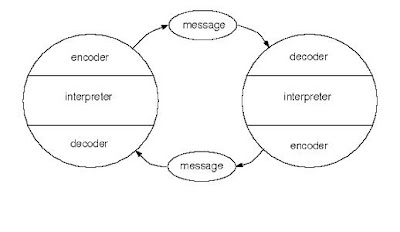
Schramm’s Model


Wilbur Schramm (1954) was one of the first to alter the mathematical model of Shannon and Weaver. He conceived of decoding and encoding as activities maintained simultaneously by sender and receiver; he also made provisions for a two-way interchange of messages. Notice also the inclusion of an “interpreter” as an abstract representation of the problem of meaning.


Classical Communication Models

1. Aristotle’s definition of rhetoric. Ehninger, Gronbeck and Monroe: One of the earliest definitions of communication came from the Greek philosopher-teacher Aristotle (384-322 B.C.).

- “Rhetoric” is “the faculty of observing in any given case the available means of persuasion” (Rhetoric 1335b).

- Aristotle’s speaker-centered model received perhaps its fullest development in the hands of Roman educator Quintilian (ca. 35-95 A.D.), whose Institutio Oratoria was filled with advice on the full training of a “good” speaker-statesman.


These are various communication theories explained by different people. Harold Lasswell explained the communication model in 1948. He explained the model by “who says what to whom in what channel with what effect”. Shannon & Weaver’s model was introduced in 1949. They are known as the fathers of information theories and they have focused on the noise source in communication. Schramm’s first model was introduced in 1954 and focused on signal. He has also introduced the second model with field of experience. He has also introduced the third model with feedback. He was known as the founder of information studies. Katz and Lazarsfeld’s model was introduced in 1955. It was the first model to deal with mass media and communication. The Westley-Maclean model was introduced with mass media and communication in organization. At last, Kincaid’s convergence model was introduced in1979 and included mutual understanding. It is a cyclic model. All of these models are very useful in organization. These models are useful to offer convenient ways to think, to provide graphical checklists and to change to mass communications methods.

REFERENCE

http://en.wikipedia.org/wiki/Communication_theory#Communication_Theory_Framework
http://www.tcw.utwente.nl/theorieenoverzicht/
http://www.shkaminski.com/Classes/Handouts/Communication%20Models.htm

Friday, July 6, 2007

IDENTITY, IMAGE, AND REPUTATION

Identity, Image, and Reputation are very closely linked to corporate world. It is a well known thing that a close alignment between a company’s identity and image generates a strong reputation. There is a complexity in understanding the organizational level identity and image because of the potential identity options. Inappropriate and outdated identity can be damage to the firm and lead to weak financial performance.


An organization’s identity, image, and reputation are very important; not only to the company but also in how it is viewed by the various constituencies. A company’s identity is thought of as the visual expression of its reality as conveyed through the company’s name, logo, motto, products, services, or other pieces of tangible evidence created by the organization. Image is a reflection of an organization’s identity, or it is the organization as seen from the viewpoint of its constituencies. Close alignment of an organization’s identity and image will generate a strong reputation. An organization’s reputation is different from its image and identity because it is built up over time and it is a product of both internal and external constituencies.


These are few methods that many organization fallow to manage their identity process.

  • Conducting an identity audit


  • Setting identity objective


  • They develop designs and names


  • Develop prototypes


  • Launch and communicate


  • Implement the program

Implementing an identity program is a communication process which involves lots of interpersonal savvy and a coordinated approach to deal with many constituencies (investors, employees, and the community).often, a company’s image and reputation with a given constituency is driven not only by its own unique corporate identity, but also by the image of the industry or group it belongs to. Usually the demand for increased transparency, and the increasing attention paid to social responsibility speaks for a greater focus on the part of organizations to build and maintain strong reputation.


REFERENCES:

http://findarticles.com/p/articles/mi_m4339/is_2_23/ai_88252993

http://xtof.livejournal.com/13170.html


EXAMPLE:


A company’s identity is thought of as the visual expression of its reality as conveyed through the company’s name, logo, motto, products, services, or other pieces of tangible evidence created by the organization. A prime example of a company with a strong identity is Nike. I believe the Nike “swoosh” logo was a stroke of genius. The ubiquity of Nike’s logo has contributed to its global success because it has come to represent athletic excellence and quality apparel and gear.


On the subject of company image, Nike provides another good example. Allegations of sweatshop working conditions and child labor had a profound effect on Nike’s image. A salmonella outbreak seriously damaged Chi-Chi’s image which ultimately led to its bankruptcy. An organization’s reputation can be contradicting between constituents, such as employees, consumers, and investors. They may all have opposing viewpoints about the same product. Companies need to be fully aware of the tremendous impact of identity, image, and reputation and must learn how to manage these critical resources.


EXPERIENCE:-

Reputation is how an entity – a business, brand, group, person, etc. – is perceived by the public. Your reputation, to a large extent, dictates your status in any given relationship, whether that's with your peers, a potential employer, your end-users or your customers. As i was very found of burgurs, Macdownals was my favourit place to eat that, but as I was vegitarian

Sunday, June 24, 2007

COMMUNICATING STRATEGICALLY

Effective communication is one of the important tool to maintain a good working environment, inside the organization. In ancient days communication was called as “Rhetoric”. Aristotle has stated a composition of every speech, according to him every speech is composed of three parts: The speakers, the subject of whom he treats, and the person to whom it is addresses. Aristotle’s components speech, were used by business to develop a corporate communication strategy.


The modern corporate communication strategy framework consists of four parts; the corporation, message, constituencies, and constituency responses. The information flows circularly across these parts. Developing corporate strategy include setting an effective o strategy, analyzing constituencies, delivering message and responding to the constituencies.

Many small businesses fail because of small communication mistakes that could have been easily handled by employees. This is not an uncommon occurrence in the business world. Some of the top companies that are out there have great communication. In fact, employers look for the communication as the top skill when hiring students, or employees. Why is it so vital to a companies success that you have great communication skills? Well, think of it this way. If you cannot communicate an issue that is happening to your manager, then he cannot take care of it and the problem persists. This problem can be minute, or major. Either way, overlooking it and not voicing a concern can be detrimental to a small or even a large business.

Too many CEOs, mid-level managers and executives seem to believe that corporate communications is all about schmoozing with people at a networking function. Nothing could be further from the truth. Public relations (PR) – or media relations or strategic communications – is an essential management function critical to the success of any organization. Successfully implemented, strategic communications activities can add thousands of dollars in value to an organisation for minimal cost.


References:


http://www.ay4web.com/importance-communication-small-business.html

http://www.ami.org.au/amimu/0508August/0508_pr_strategic.htm

THE CHANGING ENVIRONMENT FOR BUSINESS

The business environment is changing considerably each day. Corporate communication has marked its importance in large corporations as well as smaller corporation. Technology has strengthened communication by shared knowledge which has made the whole world a small global village.

There was a change in American business after industrial revolution and this revolution created a unstable economic conditions in the developing stage and later improved itself by the way of globalization. From decades, television and news media have played a major role in conveying messages from corporations as well as government and activity groups. Technology has strengthened communication channels around the global village. Business organization must concentrate on effective communication system in order to stay in pace with changing environment.

Communication is one of the basic functions of management in any organization and its importance can hardly be overemphasized. It is a process of transmitting information, ideas, thoughts, opinions and plans between various parts of an organization. It is not possible to have human relations without communication. However, good and effective communication is required not only for good human relations but also for good and successful business.

Although globalization ultimately refers to the integration of economic institutions, much of this integration occurs through the channels of technology. Although international trade is not a new phenomenon, the advent of communications technologies has accelerated the pace and scope of trade. Previously, ideas and technologies took centuries to diffuse across the globe, not seconds. With electronic communication media, however, within an instant, the most novel ideas can reach around the globe, or news of events in one continent can drastically affect financial markets around the world.


References:

http://ezinearticles.com/?Importance-of-Communication-in-an-Organization&id=423299


http://acjournal.org/holdings/vol3/Iss3/spec1/kluver.htm